
Prof. Liwen Li
Director of the Academic Affairs Office of Beijing Foreign Studies University

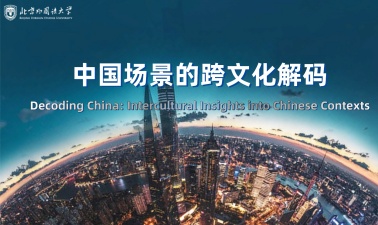
Millions of expatriates come to study, work, and live in China every year, often encountering "culture shock" in everyday situations. For instance, amid the breathtaking sea of clouds on Mount Huangshan, they wonder why everyone is so keen to capture the landscape with uniform camera shots, neatly lining up to take the exact same picture. Or at a business banquet, as a table full of sumptuous dishes is laid out before them, they may find themselves grappling with a dilemma when urged to help themselves: should they readily accept or politely decline? These are scenarios deeply embedded in China‘s social situations. While seemingly commonplace, they actually serve as a "codebook" carrying millennia of cultural DNA and contemporary social logic. Now, a MOOC specifically designed to decode this "culture shock" has arrived! Titled "Decoding China: Intercultural Insights into Chinese Contexts," the course was meticulously developed by Professor Li Liwen from Beijing Foreign Studies University. With a professional lens, it cuts through surface phenomena, delving into the cultural core, and building a "bridge of understanding" for cross-cultural exchanges between China and the rest of the world.
Total learning hours of 5 hours (Total length of the courses video 3 hours 42 minutes)
1. Identify the key cultural values embedded in typical Chinese digital, social, and business practices, such as mobile payments, group check-ins, and indirect refusals.
2. Explain how specific Chinese cultural concepts manifest in and influence behaviors across various scenarios, including business banquets, workplace communication, and family gatherings.
3. Compare and contrast Chinese cultural practices presented in the cases with those from one's own cultural background to highlight differing underlying values.
4. Analyze a given cross-cultural scenario involving a Chinese context by applying the intercultural theories and frameworks introduced in the course units.
5. Apply the decoded cultural principles to formulate appropriate and effective strategies for common intercultural situations, such as participating in a business meeting, interpreting a refusal, or selecting a gift.
1. Foreign learners and professionals in China: international students, employees in multinational corporations, expatriates, tour guides serving foreign tourists, etc.
2. Promoters of cross-cultural exchange: professionals in international trade, international education practitioners, those engaged in diplomatic affairs, etc.
3. Global enthusiasts of Chinese culture
Unit Test: 70%
Final Exam: 30% graded
Learners require no less than 70% in order to pass the course and eligible to receive the certificate
Director of the Academic Affairs Office of Beijing Foreign Studies University
e-mail: liliwen@bfsu.edu.cn

“This course is a part of Thai MOOC
Publish under the Creative Commons Attribution-NonCommercial-ShareAlike (CC BY NC SA)”